Loud Mouths, Full Bellies: The American Ramen Revolution Finally Learned to Slurp
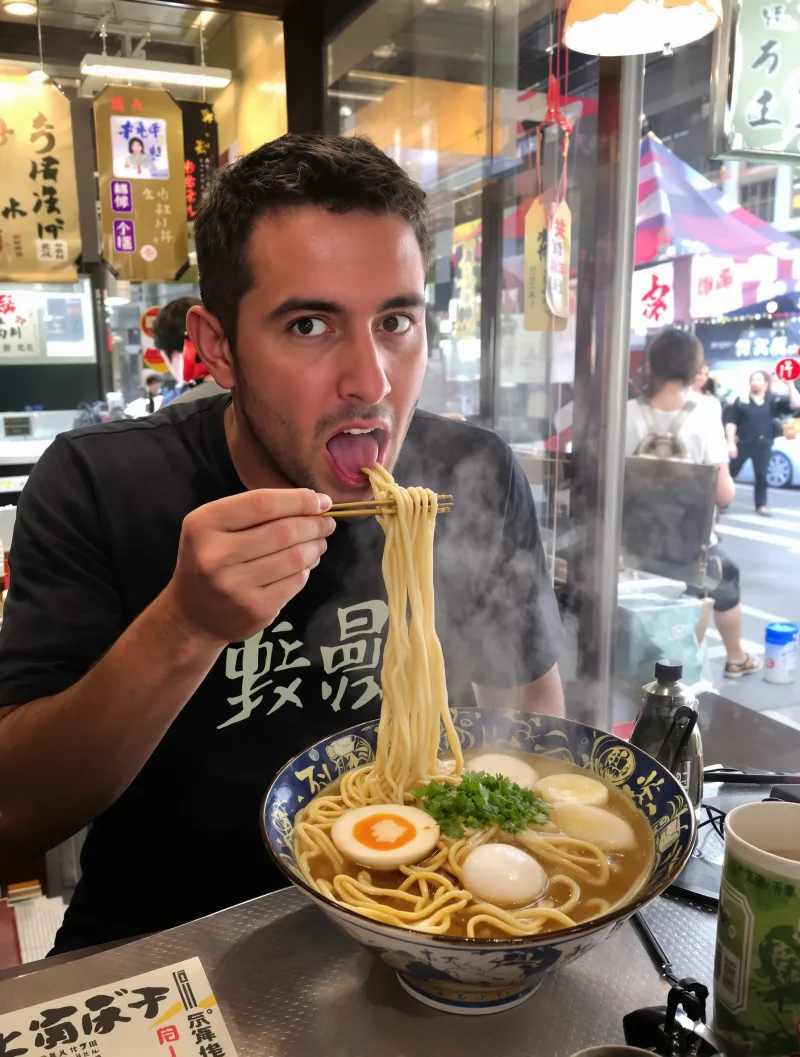
Photo: person slurping ramen noodles at restaurant counter, via pub-e2e1d4aa3c0646be8d9dbad2bfd83bc6.r2.dev
There's a specific kind of anxiety that hit American ramen shops around 2012, right when the tonkotsu boom was going nuclear in Brooklyn and the Bay Area. You'd see it at every table: a first-timer, chopsticks hovering, glancing around the room like the broth itself might be a test they hadn't studied for.
Am I supposed to slurp? Am I NOT supposed to slurp?
For years, the answer most shops gave was a shrug. Nobody wanted to lecture customers. Nobody wanted to be the guy who told a paying guest their table manners were wrong. So Americans defaulted to the only etiquette they knew — the polite, quiet, soup-on-the-down-low approach — and the ramen suffered for it.
The Broth Cools While You Hesitate
Here's the thing the etiquette-anxious crowd never understood: slurping isn't a quirk. It's engineering.
Ramen is a race against temperature. The noodles are cooked to a precise window of firmness, the broth is served scalding on purpose, and the whole bowl is built to be eaten fast. Slurping does three jobs at once — it cools the noodle as it enters your mouth, it aerates the broth so you actually taste it, and it pulls air through the fat layer so the aromatics hit before the flavor does.
Eat quietly and carefully, and by the time you're halfway through, you're eating a different, worse bowl of ramen than the chef made.
"We used to get customers who'd spend forty-five minutes on a bowl that should take twelve," says one shop owner in Portland who asked to be identified only as Ken, because — as he put it — "I'm about to tell half my customers they've been eating wrong." "Now we just tell them straight up: it's not rude here. It's a compliment. The kitchen hears you."
From Embarrassment to Education
The shift didn't happen overnight, and it didn't happen because Americans suddenly developed a taste for making noise in restaurants. It happened because ramen shop owners got tired of the ambiguity.
Walk into a serious ramen-ya in LA or Chicago or Houston these days and you'll see it on the menu, on the wall, sometimes on a little table tent: slurping encouraged. Some shops have gone further, printing mini-guides to the whole ritual — finish fast, don't linger, drink the broth last or not at all, and yes, the noise is the point.
Food culture writers deserve some credit too. The last few years have seen a wave of explainers, TikToks, and YouTube deep-dives walking Americans through why Japanese diners slurp, what it signals to the chef, and why the old "polite silence" framing was actually the rude option. The internet, for once, performed a genuine public service.
There's also a generational thing at play. Younger American diners came up through anime, travel YouTube, and the great flattening of food culture by social media. They watched Japanese vloggers demolish bowls at 2 a.m. and connected the dots themselves. To them, the slurp isn't exotic — it's just correct.
What Lands Next on the Menu
The slurp is only the beginning. A few other Japanese dining customs are quietly riding the same wave into American restaurants:
- The speed expectation. Ramen is fast food in the original, dignified sense. More US shops are dropping the fine-dining pacing and telling customers upfront: this bowl is a sprint.
- Itadakimasu as a real gesture. Not performed, not ironic — the brief acknowledgment before eating is showing up in American dining rooms as a genuine habit, not a bit.
- Counter-first seating. The omakase-style counter, where you eat facing the cook, started with sushi but is now standard at serious ramen and izakaya spots from Austin to Seattle.
- Drinking the broth at the end. A decade ago, Americans left the broth. Now finishing it — or at least being told it's an option — is part of the experience.
None of this is Japan "conquering" American dining. It's the opposite of that kind of takeout-and-assimilate story. Ramen shops in the US aren't museums; they're working restaurants run by people who want the food eaten the way it tastes best. The slurp was never etiquette at all. It was instructions nobody had translated yet.
So the next time you're at a ramen counter and you feel the old hesitation creep in — the hunch, the hush, the careful little sips — remember what the kitchen already knows. That bowl has a countdown clock on it. Make some noise. The chef is listening for it.